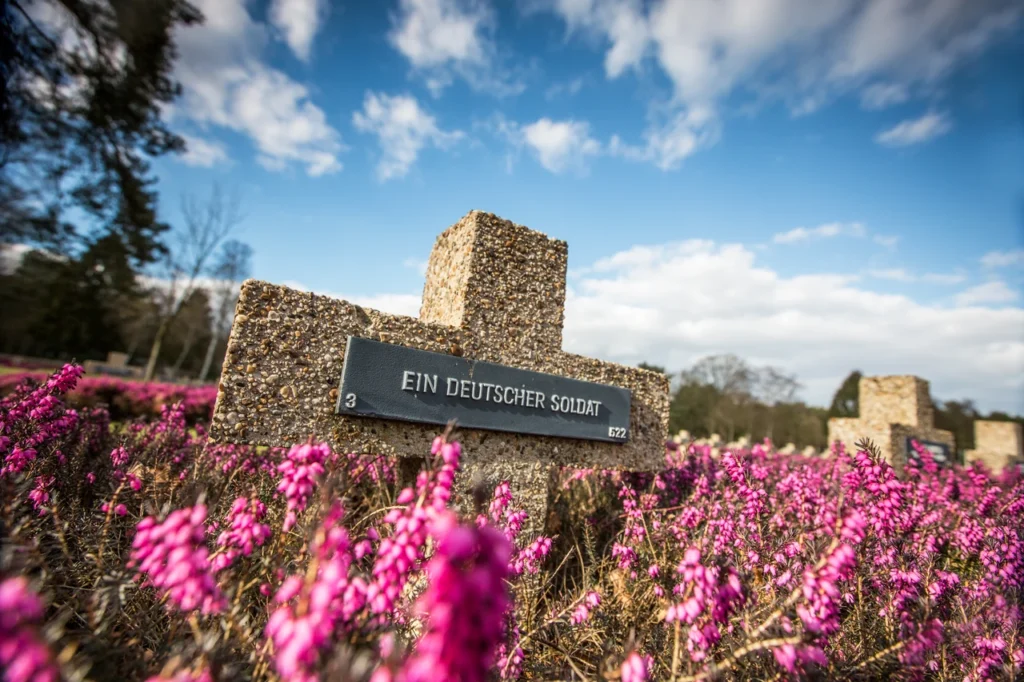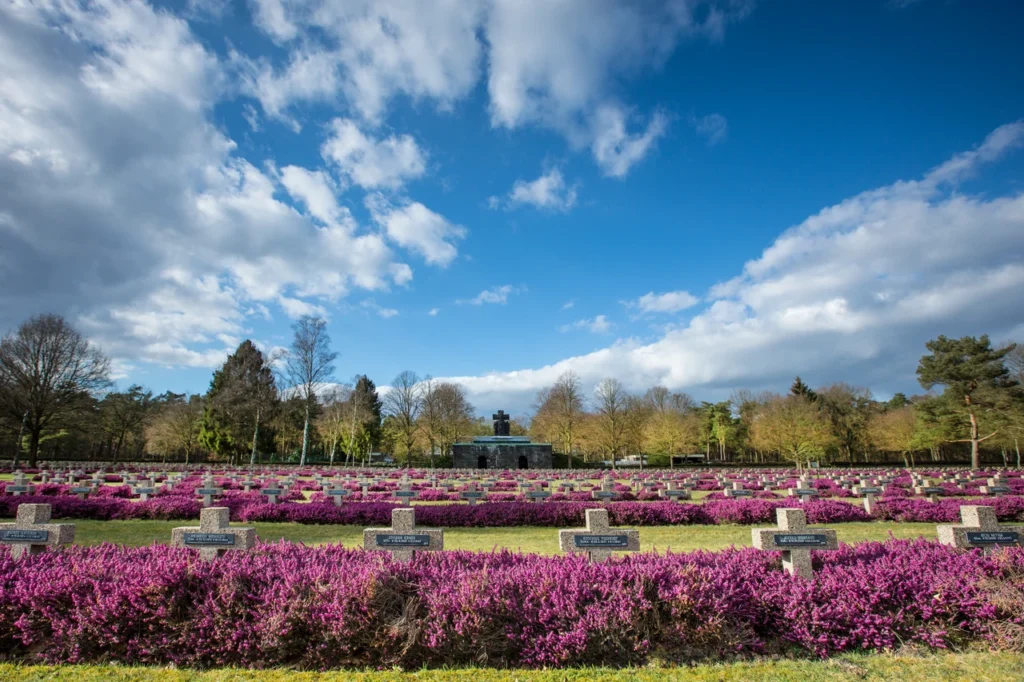
In Lommel’s German War Cemetery lie the bodies of those who served under Nazi Germany and died on Belgian soil during the Second World War. These soldiers came from fifteen different nationalities.
The Lommel German War Cemetery is the largest German cemetery in Western Europe outside Germany. Established by the Belgian government in 1946, it contains the graves of soldiers who served in the Wehrmacht during the Second World War and died in Belgium. It is cared for and maintained by the Volksbund Deutsche Kriegsgräberfürsorge.
Today, 39,111 bodies are buried in Lommel, 6,221 of whom remain unidentified.
The cemetery presents the graves both as a collective resting place and as a conglomerate of 39,111 individual stories. These personal histories reveal the diverse demographics of the Wehrmacht: soldiers from up to fifteen nationalities rest here.
Among them are men from the Baltic countries, Central Asia, the Caucasus, and former Soviet-influenced states such as Ukraine, Romania, and Bulgaria, who joined the German forces in opposition to Stalinist rule. There are also cases of soldiers from China and the United States, all of German descent.
Religious diversity is also reflected in the cemetery. While many soldiers were Catholic, there is evidence of Islamic faith, especially among those from Central Asia, and even a few Jewish members.
Those buried here took part in major battles such as the Hürtgen Forest and Aachen. Some casualties from the Battle of the Bulge are also interred at Lommel.