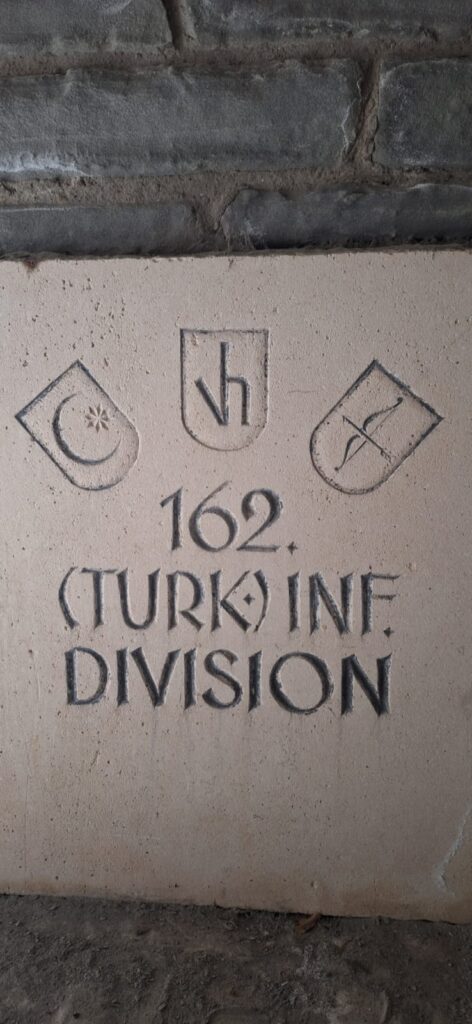
When you walk into one of the caves of this memorial of the German divisions killed during World War II, you could be surprised by a special commemoration plaque mentioning a Turkish division. Yet, why are Turkish people commemorated there?
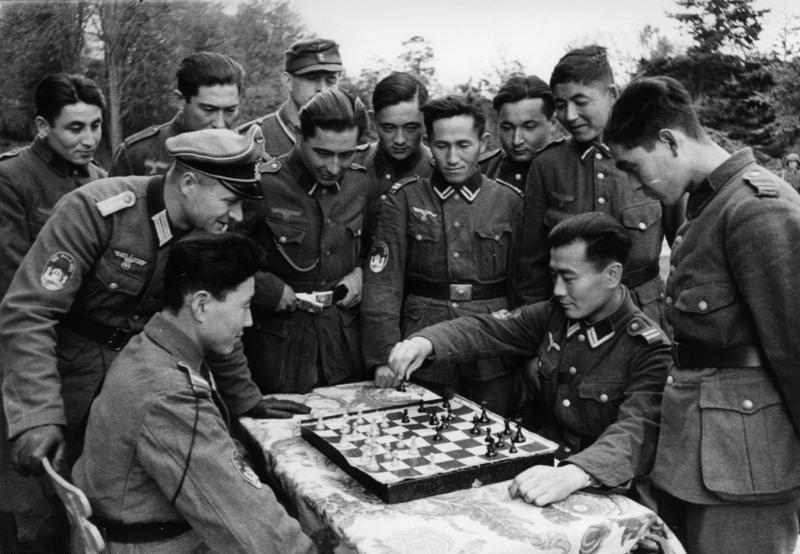
This division was created in Poland in 1943 replacing the disbanded 162nd division. Its aim was to form national units which could be used to defeat the Red Army in the USSR. During this activity time, the 162 (Turk) inf. division was the most important of the Ostlegionen, the group of Eastern Europe legions of the 3rd Reich. It was active from May 1943 to September 1943 in Poland before it was removed to Italy and Slovenia from September 1943 to May 1945. During this last period, the division was used to defend the Gothic line in Northern Italy.
Nevertheless, if the commemorative plaque mentioned an entity of “Turkish” people, it seems to obliterate the multinational composition of this division. Indeed, even if it was not a particularity of the contemporary era, the term “Turkish” refers to a very large group of peoples and nations even more since the collapse of the Ottoman Empire and the creation of Turkey in 1923. Therefore, in this division there were USSR nationals (especially Azerbaijani and Turkestan), Uzbek, Kazakh, Turkmen and Kyrgyz. Most of them were prisoners captured among the Red Army. But some were also anti-communists or anti-soviets men who defected from the USSR army.
During their operations in Northern Italy, the 162 division was under the command of various German Armies. They were especially involved in operations against the partisans as in La Spezia or in Rimini in 1943 and 1944. This division was recognized as one of the most efficient militarily speaking within the German troops. However, they were also guilty of war crimes like in January 1945 when they killed at least 40 civilians in Emilia-Romagna. After many battles against partisans and allies, the 162 division was defeated by the British in Austria while the Italian frontline stepped back.
The 162 Turkestan division shows how internationalized this war has been. Therefore, the memory of this major event of the 20th century is very specific in the sense that it must integrate various situations such as nationality, political tendency or social status. Thus, it seems important not to simplify the reality of the operations or people involved and try to understand the complexity of a war that is not only a European war but definitely a World War.